

The current reporting landscape shows that sustainability disclosure is becoming embedded across company sizes, with 96% of the world’s largest 250 companies reporting on sustainability and 72.9% of mid-market businesses continuing their sustainability reporting. This makes ESG data critically important because investors and regulators are demanding its validity, which serves as the most significant signal of transparent disclosures.
ESG data management, if done right, has major significance for compliance, stakeholder trust, capital access, and informed business decisions. At the same time, ESG data management software can optimize the reporting process, so companies seeking that kind of report must choose wisely.
ESG data refers to the environmental, social, and governance information companies use to measure and disclose their sustainability and ethical performance. It covers a wide range of metrics across three pillars of corporate accountability.
Environmental data includes Scope 1, 2, and 3 greenhouse gas emissions, energy consumption, water use, waste, and climate-related metrics aligned with frameworks such as TCFD and ISSB. Social data includes workforce safety, diversity and inclusion, pay equity, supply chain labor practices, and privacy incidents. Governance data covers board composition, director independence, anti-corruption efforts, executive compensation, internal controls, and cybersecurity measures.
High-quality ESG data should be accurate, auditable, and applicable. Accurate data supports reliable disclosures and reduces compliance risk. Auditable data creates a clear record of what changed, when, by whom, and on what basis. Applicable data helps organizations move beyond reporting to identify risks, improve performance, and support strategic decisions.
ESG data management is difficult because organizations are dealing with several connected challenges at once. ESG information often comes from operations, procurement, finance, HR, and external suppliers, making integration difficult and leaving companies with fragmented or inconsistent inputs. Data quality remains a persistent concern, especially in areas such as Scope 3 emissions, supplier disclosures, and social metrics, where estimates and incomplete inputs are common.
As disclosure requirements expand under frameworks such as CSRD, ISSB, TCFD, and GRI, datasets are becoming larger and more complex, creating scalability pressures for organizations without strong infrastructure. At the same time, governance expectations require ESG data to be well documented and ready for external assurance. Many organizations also struggle to turn dashboards into meaningful insight. Added to this are security and privacy risks, since ESG data often includes sensitive supplier, employee, and strategic information.
Effective ESG data collection and reporting require more than compliance. Organizations need systems that improve data quality, strengthen accountability, and can help them make smarter decisions. The following practices help build that foundation.
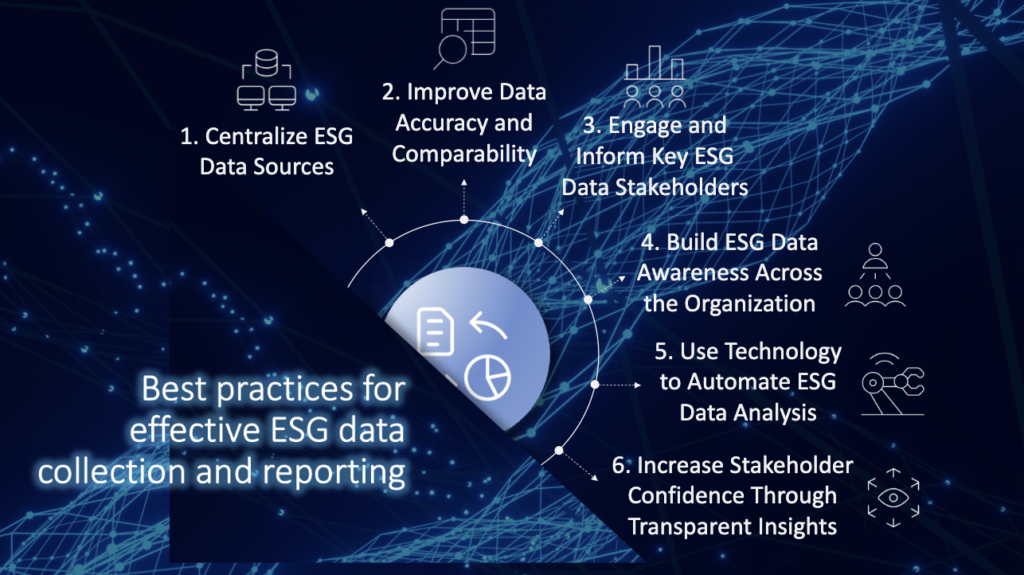
1. Centralize ESG data sources
ESG data is often spread across operations, procurement, finance, HR, and suppliers. Bringing it into one system reduces duplication, limits manual work, and creates a clearer view of performance. It also improves consistency, version control, and reporting efficiency.
2. Improve data accuracy and comparability
Trusted ESG reporting depends on consistent methodologies, standardized metrics, and clear calculation rules. Validation, documentation, and review processes help reduce errors and make data more comparable across business units, time periods, and frameworks.
3. Engage key ESG stakeholders
ESG reporting requires input from multiple functions, including sustainability, finance, operations, HR, procurement, legal, and leadership. Early engagement improves coordination, clarifies ownership, and helps ensure the right data is collected on time.
4. Build ESG data awareness across the organization
Reporting improves when employees understand how ESG data supports compliance, risk management, investor communication, and performance improvement. Greater awareness encourages stronger ownership and more consistent data practices across teams.
5. Use technology to automate ESG data analysis
Technology helps make ESG reporting more scalable and reliable. Automation reduces manual effort, improves traceability, speeds up analysis, and helps identify trends or inconsistencies across large datasets.
6. Increase stakeholder confidence through transparent insights
Clear and transparent reporting builds trust. Stakeholders are more likely to rely on ESG disclosures when results are supported by traceable evidence, clear methodologies, and honest communication about progress and limitations.
The ESG data management software market offers specialized solutions that address different organizational priorities. Each platform brings distinct capabilities to emissions tracking, regulatory compliance, and stakeholder reporting.
Persefoni is an ESG data management platform best known for its strength in carbon accounting, especially for organizations that need disciplined, audit-ready emissions reporting. It helps companies automate Scope 1, 2, and 3 calculations, align disclosures with the GHG Protocol, and maintain strong evidence management and audit trails. Those capabilities make it especially relevant for large enterprises, financial institutions, and firms operating in high-scrutiny regulatory or investor environments where accuracy, traceability, and assurance readiness matter. Its main advantage is depth in emissions accounting rather than broad ESG breadth.
That focus can also be a limitation: organizations looking for a wider platform spanning social, governance, operational ESG workflows, or broader sustainability performance management may find it narrower than more generalized ESG suites. In practice, Persefoni is strongest when carbon measurement, compliance discipline, and defensible reporting are the top priorities.
Watershed stands out as an ESG data management tool that combines emissions measurement with action-oriented reduction capabilities. It supports end-to-end emissions management, real-time dashboards, target tracking, and supplier engagement for Scope 3, while also integrating with ERP, HR, and procurement systems. This makes it attractive to organizations that want ESG data to do more than sit in reports; they want it to guide operational decisions, supplier collaboration, and decarbonization planning. Its support for frameworks such as SBTi, CDP, and TCFD adds value for companies balancing internal performance management with external disclosure requirements.
A possible limitation is that its strongest identity is still around carbon and climate execution, so companies seeking an equally mature platform across the full ESG spectrum may need complementary tools or processes. It is best suited to organizations prioritizing measurable emissions reduction, cross-functional visibility, and supplier-driven Scope 3 progress.
IBM Envizi is positioned as an enterprise-grade ESG data management platform with a broader scope than carbon-only tools. Its strengths lie in collecting and normalizing environmental, energy, and social data, automating data pipelines, and applying governance controls that support enterprise-wide consistency. It also offers strong visualization and root-cause analytics, which can help organizations move from raw data collection to insight generation and performance analysis.
For big, complicated companies that handle many locations, systems, and reporting requirements, this wide range of features is helpful because it builds a more unified ESG data foundation instead of just focusing on emissions. Its integrations with IBM enterprise platforms and cloud services further support organizations already invested in that ecosystem. The trade-off is that broader enterprise platforms can sometimes require more implementation effort, stronger internal data governance, and clearer process ownership to realize full value. Envizi is therefore best for organizations prioritizing scale, centralization, and multi-domain ESG data management.
SAP Sustainability Control Tower is an ESG data management solution designed for organizations that want sustainability information tightly integrated with core business systems. Built on SAP S/4HANA, it connects ESG data with financial, operational, and supply chain processes while supporting real-time KPIs, risk dashboards, and structured reporting aligned with frameworks such as ESRS, GRI, and ISSB. That makes it especially compelling for SAP-native enterprises that view ESG not as a standalone reporting exercise but as part of enterprise performance, governance, and decision-making. Its ability to align sustainability metrics with existing SAP data structures is a major strength for organizations seeking consistency, control, and enterprise-wide reporting discipline.
However, this close connection to SAP might be a drawback for companies that use different technologies or are not very advanced with SAP, as the benefits they gain may rely a lot on how well they use the SAP system. It is strongest where integration, reporting structure, and ERP-connected ESG management are the primary priorities.
Choosing ESG data management software should start with your organization’s priorities. The right platform can improve reporting efficiency, strengthen compliance readiness, and support long-term sustainability goals.
Start by defining what you need the software to do. Consider data collection and integration, reporting requirements, scalability, ease of use, visualization, and fit with your existing systems. Clear priorities will help narrow the market and focus your search.
You should also think ahead. If your ESG efforts are expected to grow, the platform should be able to handle larger data volumes, broader reporting demands, and changing business needs over time.
A strong ESG platform should support the regulations and frameworks most relevant to your business. Because many requirements overlap, software that can address multiple regulations in one place can reduce administrative effort and simplify compliance.
It should also cover the ESG topics that matter to your organization, including environmental, social, and governance factors, while remaining flexible enough to adapt as regulations and expectations evolve.
Integration is essential for effective ESG reporting. The software should connect smoothly with your financial systems, sustainability databases, and other relevant platforms so data can move consistently across the organization.
Scalability matters just as much. A flexible system should allow you to customize KPIs, reporting structures, and frameworks while also supporting growing data complexity and future regulatory change.
Cost should be assessed beyond the initial purchase. Look at the total cost of ownership, including maintenance, training, and support, to understand the full investment required.
Implementation support is equally important. Vendors that provide strong training, responsive service, and reliable documentation can reduce disruption and help your team use the platform effectively from the start.
Organizations need ESG data that is accurate, traceable, scalable, and useful not only for compliance but also for risk management, stakeholder communication, and better business decisions. Effective ESG reporting does not solely depend on software; it requires clear governance, cross-functional ownership, and a structured approach to data collection, validation, and analysis. Companies that build these capabilities early will be better positioned to respond to regulatory change, strengthen stakeholder trust, and turn sustainability reporting into a source of strategic value. Our new ESG data management course is live. Join us and get hands-on understanding of structured data management, governance practices, and digital tools that enable reliable ESG reporting and more informed sustainability decision-making.